
DeCAF Seminar Series:
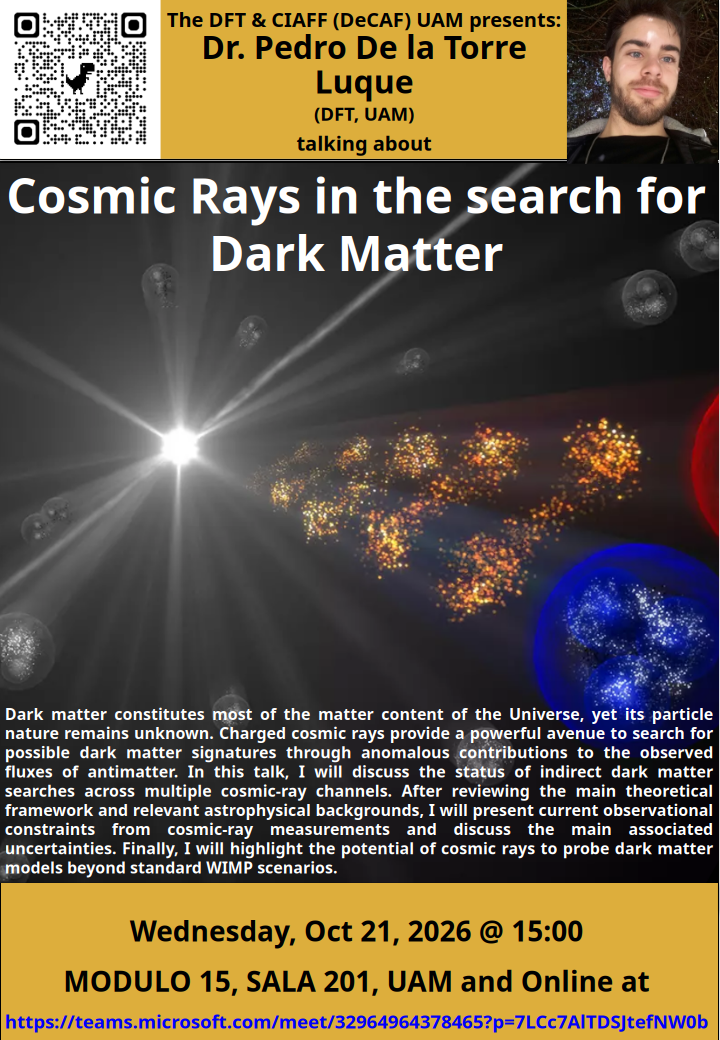
Abstract: Dark matter constitutes most of the matter content of the Universe, yet its particle nature remains unknown. Charged cosmic rays provide a powerful avenue to search for possible dark matter signatures through anomalous contributions to the observed fluxes of antimatter. In this talk, I will discuss the status of indirect dark matter searches across multiple cosmic-ray channels. After reviewing the main theoretical framework and relevant astrophysical backgrounds, I will present current observational constraints from cosmic-ray measurements and discuss the main associated uncertainties. Finally, I will highlight the potential of cosmic rays to probe dark matter models beyond standard WIMP scenarios.
Speaker Bio: Pedro De la Torre Luque is a Ramón y Cajal researcher at the Universidad Autónoma de Madrid. He obtained his PhD in astroparticle physics from the University of Bari and subsequently worked at Stockholm University and the Oskar Klein Centre. Before starting his current position, he was working as a Juan de la Cierva fellow at the Instituto de Física Teórica UAM-CSIC. His research focuses on astroparticle physics, cosmic-ray propagation, and indirect searches for physics beyond the Standard Model. In particular, he studies dark matter and its signatures in cosmic rays, gamma rays, neutrinos and other astrophysical observables. He is also involved in the Fermi-LAT and CTAO collaborations and in the development of cosmic-ray propagation tools such as DRAGON.