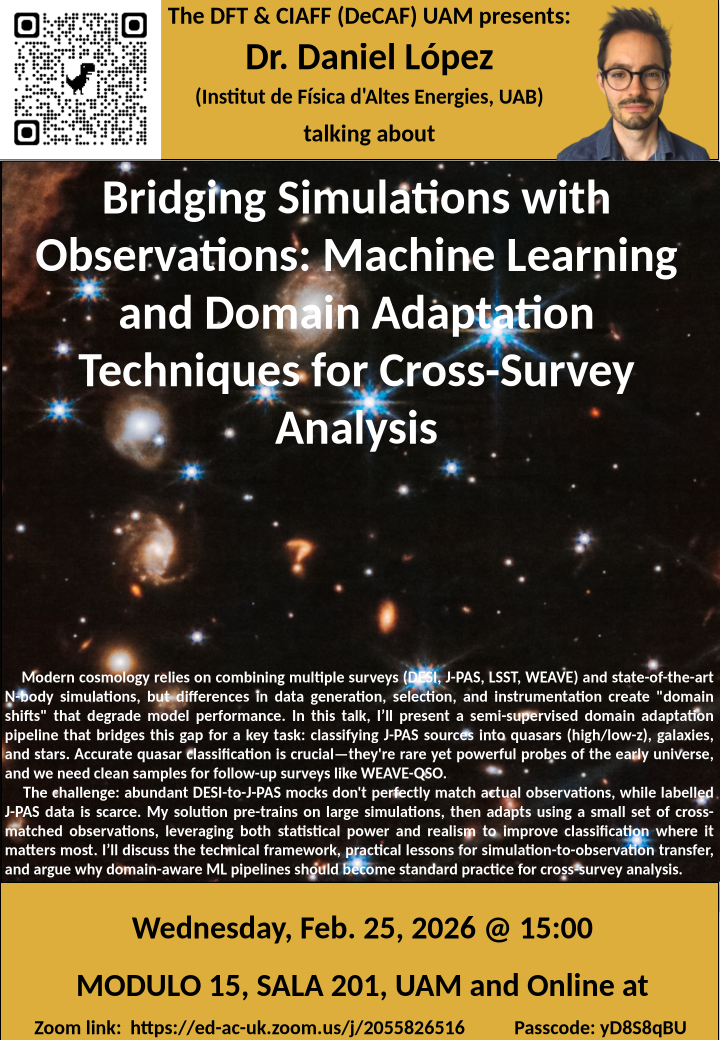


Abstract: Modern cosmology relies on combining multiple surveys (DESI, J-PAS, LSST, WEAVE) and state-of-the-art N-body simulations, but differences in data generation, selection, and instrumentation create "domain shifts" that degrade model performance. In this talk, I’ll present a semi-supervised domain adaptation pipeline that bridges this gap for a key task: classifying J-PAS sources into quasars (high/low-z), galaxies, and stars. Accurate quasar classification is crucial—they're rare yet powerful probes of the early universe, and we need clean samples for follow-up surveys like WEAVE-QSO. The challenge: abundant DESI-to-J-PAS mocks don't perfectly match actual observations, while labelled J-PAS data is scarce. My solution pre-trains on large simulations, then adapts using a small set of cross-matched observations, leveraging both statistical power and realism to improve classification where it matters most. I’ll discuss the technical framework, practical lessons for simulation-to-observation transfer, and argue why domain-aware ML pipelines should become standard practice for cross-survey analysis.
Speaker Bio: Dr Daniel López did his BSc and MSc in Physics at UAM/IFT (Madrid), where Alexander Knebe supervised his master's thesis related to galaxy statistics using semi-analytical models. He then completed his PhD at DIPC (Donostia) under Raúl Angulo, working on N-body simulations and structure formation processes. He is currently a FAPESP postdoctoral fellow at IFUSP (São Paulo), working with Raul Abramo, employing ML tools for cross-survey analysis. From February to July this year, He will be at IFAE (Barcelona) with Jonás Chaves and Andreu Font, studying Ly-α forest modelling.